Loading...

Loading...

RDMA The Networking Foundation Behind Modern AI Infrastructure
The AI industry has entered an era of unprecedented scale.
Training modern large language models no longer involves a handful of servers. Today's AI clusters may contain hundreds or thousands of GPUs working together across an Ethernet fabric, exchanging massive volumes of data throughout the training process.
As organizations invest millions of dollars in GPU infrastructure, a new challenge has emerged:
The network is no longer just connecting servers—it is directly impacting GPU utilization and AI training efficiency.
In traditional data centers, network performance was important but rarely the primary bottleneck. In AI environments, however, communication between GPUs often determines how effectively the entire cluster performs.
This is why technologies such as Remote Direct Memory Access (RDMA) have become a critical component of modern AI infrastructure.
The Hidden Bottleneck in AI Training
When people think about AI infrastructure, they often focus on GPUs.
More GPUs typically mean more computing power. However, adding GPUs alone does not guarantee faster model training.
Modern distributed AI training requires GPUs to constantly exchange gradients, parameters, and synchronization information. Operations such as AllReduce and AllGather generate enormous east-west traffic across the data center network.
As clusters scale, communication overhead grows rapidly.
If data cannot move efficiently between GPUs, expensive compute resources spend time waiting for information rather than performing computation. The result is lower GPU utilization and longer training times.
In many large-scale deployments, network efficiency becomes just as important as GPU performance.
Why Traditional Networking Falls Short
Most enterprise networks rely on TCP/IP communication.
While TCP provides reliable data delivery, it was never designed for the communication patterns generated by modern AI workloads.
In a traditional networking model, every packet passes through the operating system's networking stack, consuming CPU resources and introducing additional latency through:
● Protocol processing
● Memory copying
● Context switching
● Interrupt handling
For web applications and general enterprise workloads, these overheads are acceptable.
For AI clusters exchanging terabytes of data every second, they quickly become a bottleneck.
As network speeds increase from 100G to 400G and beyond, reducing communication overhead becomes increasingly important.
This challenge led to the adoption of RDMA.
What Is RDMA?
Remote Direct Memory Access (RDMA) is a networking technology that enables one server to directly access the memory of another server without involving the remote CPU or operating system.
Rather than treating communication as packet delivery between software stacks, RDMA treats communication as direct memory-to-memory data movement.
By offloading communication tasks to specialized RDMA-capable network adapters, RDMA significantly reduces latency while minimizing CPU utilization.
The result is:
● Faster data transfers
● Lower communication latency
● Reduced CPU overhead
● Improved application performance
For distributed AI workloads, these advantages can translate directly into higher GPU efficiency.
Why RDMA Has Become Essential for AI Infrastructure
The value of RDMA becomes particularly evident in large AI clusters.
Distributed training frameworks require thousands of communication events between GPUs during every training iteration. Even small delays can accumulate into significant performance losses across the cluster.
RDMA helps address this challenge by enabling:
Low-Latency Communication
By bypassing much of the traditional networking stack, RDMA reduces communication delays between compute nodes.
Efficient CPU Utilization
Instead of dedicating CPU cycles to networking tasks, servers can allocate more resources to AI workloads.
Improved GPU Efficiency
Faster communication allows GPUs to spend more time computing and less time waiting for data synchronization.
Better Scalability
As AI clusters grow from dozens to thousands of GPUs, RDMA helps maintain efficient communication across the fabric.
These advantages have made RDMA a foundational technology for modern AI networks.
RoCEv2: Bringing RDMA to Ethernet Networks
While RDMA originated in InfiniBand environments, many organizations today prefer to build AI infrastructure using Ethernet.
This has driven the adoption of RoCEv2 (RDMA over Converged Ethernet v2), which enables RDMA communication across standard Ethernet networks.
RoCEv2 combines the performance advantages of RDMA with the flexibility and scalability of Ethernet, making it the preferred architecture for many AI deployments.
However, successfully deploying RoCEv2 requires more than simply enabling RDMA-capable network adapters.
The underlying network fabric must also be designed to support RDMA traffic.
Why the Network Matters in RDMA Deployments
A common misconception is that RDMA performance is determined primarily by servers and NICs.
In reality, the network fabric plays a critical role.
RoCEv2 environments are highly sensitive to congestion, packet loss, and latency variation. As AI clusters grow, network design becomes increasingly important.
To support RDMA efficiently, the switching infrastructure must provide:
● Low-latency forwarding
● High-bandwidth connectivity
● Intelligent congestion management
● Lossless Ethernet capabilities
● Scalable leaf-spine architectures
Without these capabilities, organizations may encounter:
● Reduced GPU utilization
● Network congestion
● Throughput degradation
● Unpredictable application performance
In other words, RDMA performance depends not only on the servers but also on the quality of the network fabric connecting them.
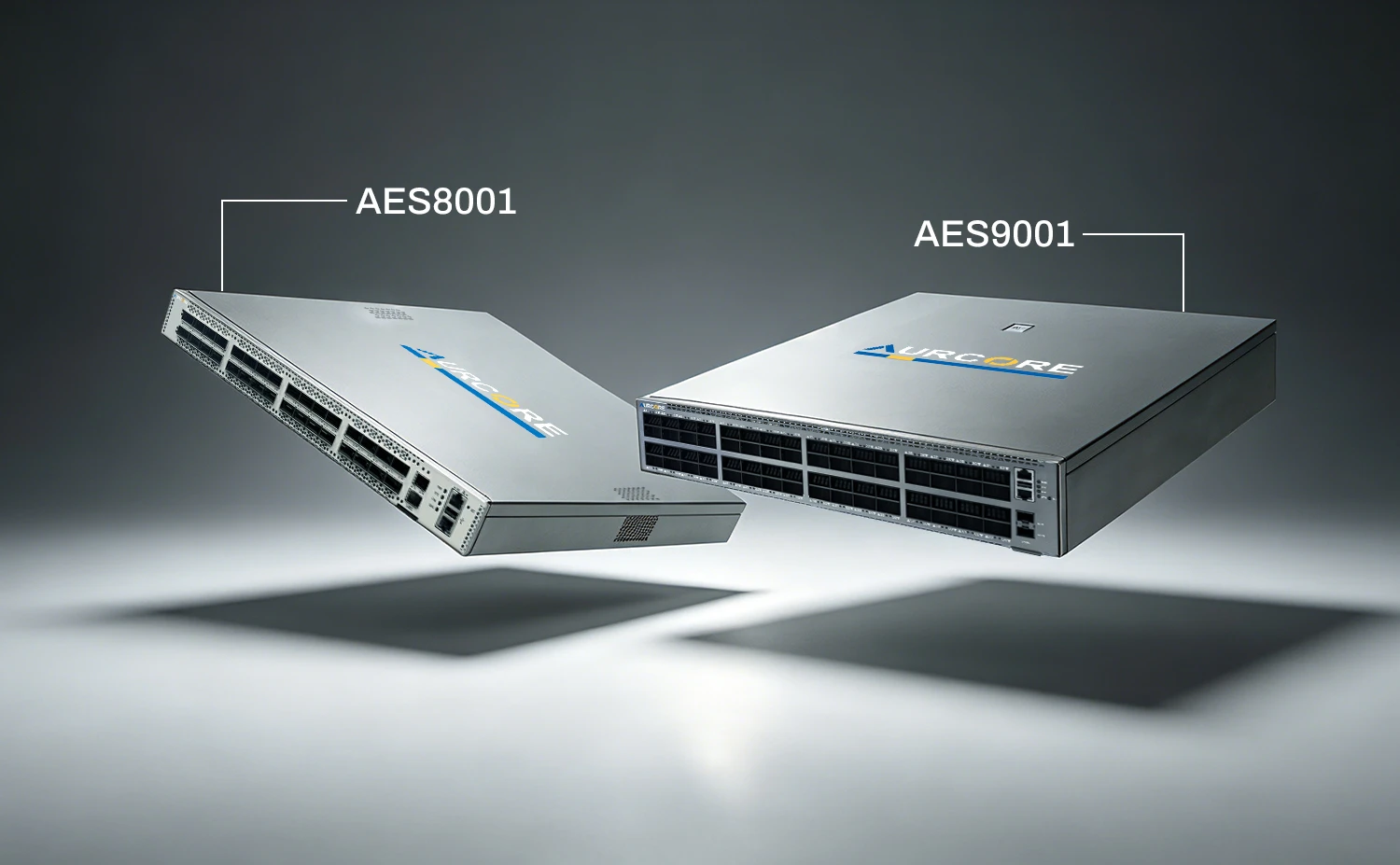
How AurCore Switches Enable High-Performance RDMA Networks
Building a successful RDMA fabric requires more than deploying RDMA-capable NICs. As AI clusters scale from hundreds to thousands of GPUs, the switching infrastructure becomes a critical factor in determining overall training efficiency.
AurCore data center switches are purpose-built for AI fabrics and large-scale RoCEv2 deployments, delivering the low latency, high bandwidth, and lossless transport required by modern GPU clusters.
1. Ultra-Low Latency for Distributed AI Workloads
AI training performance is highly sensitive to communication latency between GPUs.
AurCore switches deliver as low as 500 ns port-to-port latency, helping reduce communication delays across the fabric and enabling faster synchronization during collective operations such as AllReduce and AllGather.
Combined with optimized RoCEv2 forwarding, AurCore helps maintain microsecond-level GPU-to-GPU communication latency, ensuring that compute resources spend more time training and less time waiting for data.
2. Designed for Lossless RoCEv2 Fabrics
RoCEv2 environments depend on predictable, lossless transport to achieve maximum performance.
AurCore switches support key lossless Ethernet technologies, including PFC, ECN, ETS, and DCB, helping minimize packet loss, reduce congestion impacts, and maintain stable RDMA communication under heavy AI workloads.
This enables organizations to build scalable Ethernet fabrics capable of supporting demanding distributed training applications.
3. High-Density Connectivity for AI Scale-Out Networks
As AI clusters continue to grow, network scalability becomes increasingly important.
AurCore platforms provide high-density 100G, 400G, and 800G connectivity, enabling efficient leaf-spine architectures while reducing network tiers and simplifying large-scale deployments.
The result is a fabric architecture capable of supporting next-generation GPU clusters without compromising performance.
4. Optimized for Maximum Network Utilization
Raw bandwidth alone is not enough. The real measure of an AI network is how effectively available bandwidth can be utilized.
In NCCL performance testing, AurCore switching fabrics have demonstrated up to 94% network utilization, helping maximize throughput during distributed GPU communication and improving overall training efficiency.
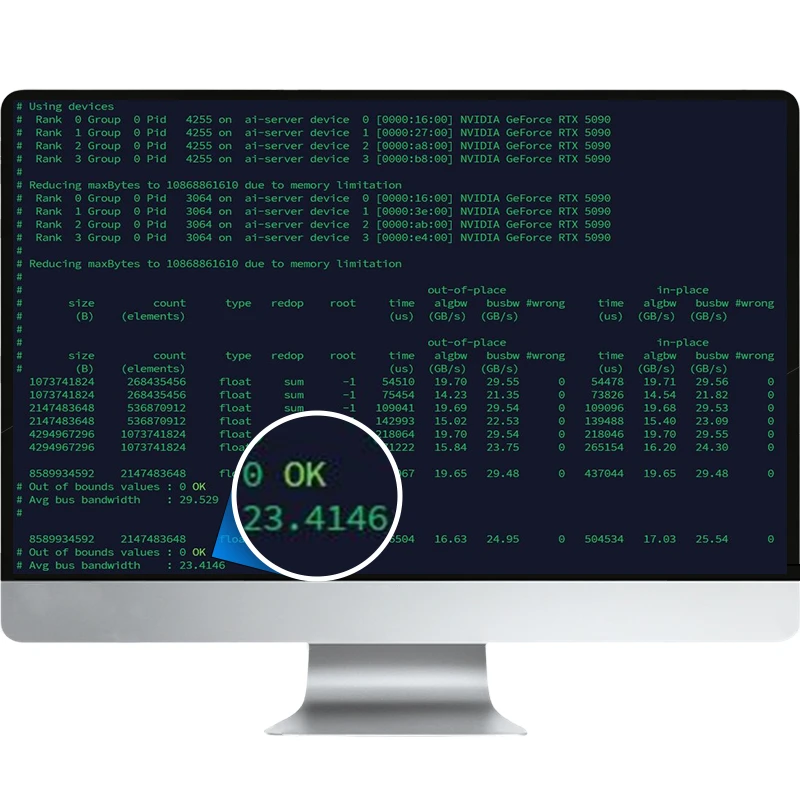
Higher network efficiency means faster job completion and better utilization of expensive GPU resources.
5. High-Power Optical Support for AI Data Centers
Modern AI fabrics increasingly rely on high-speed optical interconnects.
AurCore switches support high-power optical modules up to 18W per port, providing flexibility for deploying high-performance 400G and 800G optical connectivity across large-scale AI infrastructure.
This enables customers to build larger, denser, and more scalable AI networks while maintaining operational flexibility.
By combining ultra-low latency, lossless Ethernet capabilities, high-density connectivity, and industry-leading network efficiency, AurCore switches provide the network foundation required for modern RDMA and AI deployments.
As AI infrastructure continues to scale, organizations need more than bandwidth—they need a network designed to maximize GPU performance. AurCore delivers the switching platform that helps make that possible.